Fullscreen
3d browser Print

OpenId

OpenID authentication (introduced in TikiWiki 2.0) is an open and decentralized identity system, designed "not to crumble if one company turns evil or goes out of business".

Basically, it allows users to select a single username (and password) that can be used by any website that uses OpenID authentication.

See http://openid.net (external link) for more information.


To enable OpenID


To use OpenID

  1. A user must have (or create) an OpenID. See http://openid.net/get/ (external link) for information on getting an OpenID.
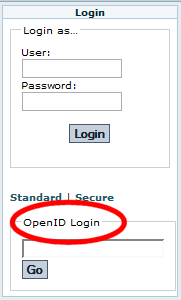
  2. In the Tiki Login Module, enter your OpenID.
    TikiWiki will attempt to validate the user's OpenID. The user will be requested to authenticate their ID with their OpenID provider.
  3. Upon successful authentication, TikiWiki will allow you to:
    • Create a new TikiWiki login.
    • Associate an existing login with your OpenID.
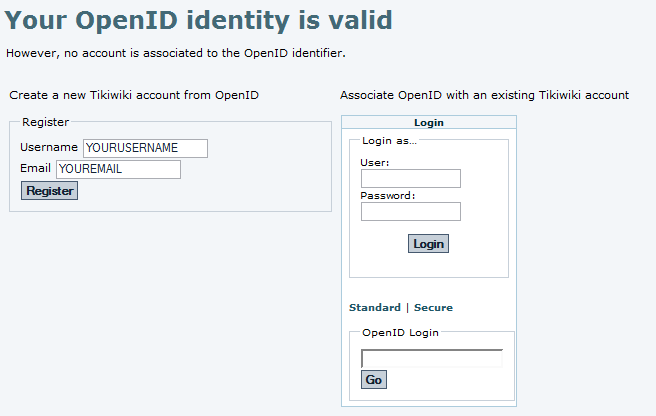
    Associating an OpenID with a TikiWiki login
  4. To create a new TikiWiki login, enter username and email address.
    TikiWiki will register the new username and associate it with your OpenID.


    If you already have a TikiWiki login, enter your username and password in the Login area.
    TikiWiki will associate the existing TikiWiki login with your OpenID.

  5. To login, you can now simply use your OpenID on the Login Module.


Note: After associating an OpenID with a TikiWiki user account, you cannot unassociate the two through the TikiWiki Administration interface. Instead, you must edit the database, directly. In the users_users table, reset the openid_url for the user to null.

Contributors to this page: ricks991415 points  , marclaporte2945 points  and xavidp659 points  .
Page last modified on Wednesday 10 December, 2008 21:15:22 UTC by ricks991415 points .

Documentation Menu

To register

To have an account at this site, please register at Tikiwiki.org (external link), and then use that user name and password to log in here.

This site gets user information from Tikiwiki.org with the InterTiki feature.

Folksonomy

Anti-Bot verification code: Random Image
Enter the code you see above:

Compare

Wiki Feature Comparison

Search by Page Name

Exact match

Menu

Keywords

The following is a list of keywords that should serve as hubs for navigation within the Tiki documentation and should correspond to development keywords (bug reports and feature requests):

Accessibility (WAI – 508)
Action log 2.x
Alert 3.x
Articles & Submissions
Backlinks
Backup
Banner
Blog
Bookmark
Browser Compatibility
Cache
Calendar
Category
Charts
Chat
Comments
Communication Center
Compression (gzip)
Contacts Address book
Contact us
Content template
Contribution 2.x
Cookie
Copyright
Custom Home (and Group Home Page)
Database independence
Date and Time
Debugger Console
Directory (of hyperlinks)
Documentation link from Tiki to doc.tikiwiki.org (Help System)
DogFood
Drawing
Dynamic Content
Dynamic Variable
External Authentication
FAQ
Featured links
File Gallery
Forum
Friendship Network (Community)
Game
Gmap Google maps
Group
Hotword
HTML Page
i18n (Multilingual, l10n, Babelfish)
Image Gallery
Import-Export
Install
Integrator
Interaction
Inter-User Messages
InterTiki
JS Calendar
Karma
Live Support
Login
Look and Feel
Lost edit protection
Mail-in
Map with Mapserver
Menu
Meta Tags
Mobile Tiki and Voice Tiki
Mods
Module
Mootools 2.x
Multimedia 2.x
MultiTiki
MyTiki
Newsletter
Newsreader
Notepad
PDF
Performance Speed / Load
Permission
Platform independence (Linux-Apache, Windows/IIS, Mac, BSD)
Poll
Profile Manager
Quicktags
Quiz
Rating
RSS
Score
Search engine optimization
Search
Security
Semantic links 3.x
Shadowbox
Shoutbox
Slideshow
Smarty Template
Smiley
Spam protection (Anti-bot CATPCHA)
Spellcheck
Spreadsheet
Stats
Survey
System log
Tags 2.x
Task
Tell a Friend + Social Bookmarking 2.x
TikiTests 2.x
Theme
Trackers
TRIM
User Administration including registration and banning
User Files
User Menu
Watch
WebHelp
Webmail
Webservices
Wiki 3D
Wiki History, page rename, etc
Wiki Page Staging and Approval 2.x
Wiki Plugins extends basic syntax
Wiki Syntax
Wiki structure (book and table of content)
Workflow (Galaxia Workflow engine)
WYSIWYCA
WYSIWYG 2.x
XMLRPC